What are binaural beats and how do they work?
How two slightly different frequencies create a third tone inside your brain — and why it matters.
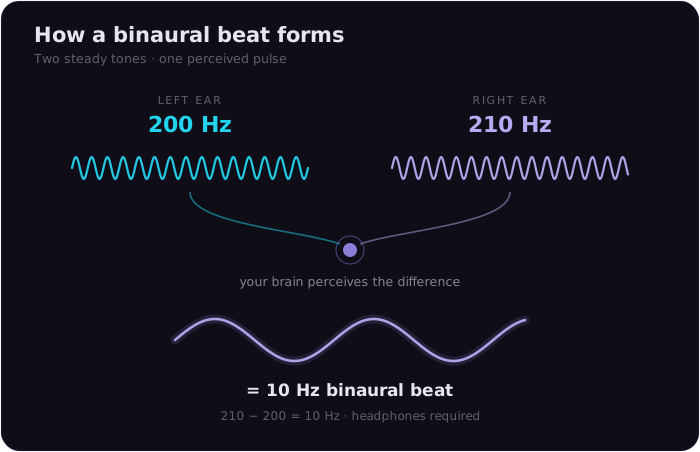
Put on headphones, play a 200 Hz tone in your left ear and a 210 Hz tone in your right ear, and something interesting happens: your brain perceives a gentle pulsing at 10 Hz — even though that frequency isn't in either signal. That phantom pulse is a binaural beat.
Discovered in 1839 by Prussian physicist Heinrich Wilhelm Dove and later explored by biophysicist Gerald Oster in the 1970s, binaural beats have become one of the most studied forms of auditory brainwave entrainment. But how do they actually work, and can they really change your mental state?
How binaural beats work
Your brain constantly produces electrical activity in the form of brainwaves. These waves oscillate at different frequencies depending on your mental state — slower during deep sleep, faster during intense focus.
When you listen to two tones at slightly different frequencies through headphones (one in each ear), your brain detects the difference between them. If your left ear hears 200 Hz and your right ear hears 210 Hz, your brain generates a perceived beat at the difference: 10 Hz.
This is the binaural beat. It's not in the audio — it's created by your auditory processing system. And research suggests that this perceived rhythm can gently encourage your brainwaves to synchronize with it, a process called frequency-following response or neural entrainment.
The five brainwave bands
Brainwaves are categorized into five main bands, each associated with different mental states:
| Band | Frequency | Associated state |
|---|---|---|
| Delta | 0.5 – 4 Hz | Deep sleep, restoration |
| Theta | 4 – 8 Hz | Meditation, drowsiness, creativity |
| Alpha | 8 – 14 Hz | Relaxation, calm focus |
| Beta | 14 – 30 Hz | Active thinking, concentration |
| Gamma | 30 – 100 Hz | Peak cognition, memory formation |
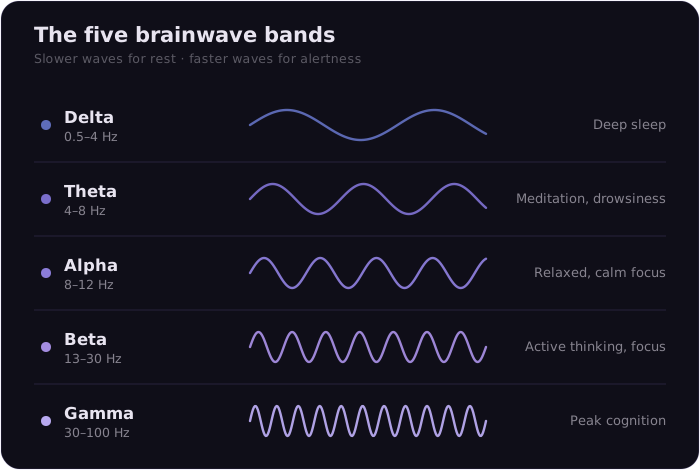
By choosing the right beat frequency, you can target the brainwave state you want. A 3 Hz binaural beat targets the delta band (deep sleep), while a 14 Hz beat targets beta (focused thinking).
What does the research say?
Binaural beats have been studied across dozens of peer-reviewed papers. The evidence is promising, though researchers note that effects can vary between individuals.
A 2019 meta-analysis published in Psychological Research by Garcia-Argibay and colleagues analyzed multiple studies and found that binaural beats can influence memory, attention, anxiety, and pain perception. The effects were most consistent for anxiety reduction.
A study in Physiology & Behavior by Lane et al. (1998) found that binaural beat exposure measurably affected vigilance performance and mood, with theta-frequency beats inducing more relaxed states and beta-frequency beats promoting alertness.
Chaieb et al. (2015), writing in Frontiers in Psychiatry, reviewed the literature on auditory beat stimulation and concluded that while results vary, there is sufficient evidence that binaural beats can modulate cognition and mood states.
Binaural beats vs. other entrainment methods
Binaural beats aren't the only way to entrain brainwaves. Two other methods are commonly used. For a full breakdown, see our guide on binaural beats vs isochronic tones.
Monaural beats
Unlike binaural beats, monaural beats are created by mixing two tones together before they reach your ears. The resulting amplitude-modulated signal is a physical sound wave — your brain doesn't need to generate it internally. This means monaural beats work without headphones, but many users find them harsher-sounding.
Isochronic tones
Isochronic tones use evenly spaced pulses of a single tone, turning on and off at the target frequency. They produce a distinct rhythmic clicking or pulsing sound. Some researchers believe isochronic tones may produce stronger entrainment because the sharp on/off pattern creates a more defined signal for the brain to follow.
Each method has its strengths. Binaural beats are the most studied and generally the most pleasant to listen to. Monaural beats and isochronic tones don't require headphones, making them useful in different situations.
How to use binaural beats effectively
Getting the most from binaural beats comes down to a few simple practices:
- Use headphones. Binaural beats require stereo separation — each ear needs to receive a different frequency. Over-ear headphones typically provide the best experience.
- Keep the volume low. The beats should be subtle, not loud. Many people layer them under ambient sounds or music for a more comfortable experience.
- Choose the right frequency for your goal. Want to focus? Try an alpha or low beta beat (10–14 Hz). Want to sleep? Go for delta (1–3 Hz). Meditating? Theta (4–7 Hz) is the sweet spot.
- Give it time. Entrainment isn't instant. Most studies use sessions of 15–30 minutes. Let your brain settle in.
- Be consistent. Like meditation or exercise, regular use tends to produce more noticeable effects over time.
Who should be cautious?
Binaural beats are generally safe for most people, but certain groups should exercise caution or consult a healthcare professional:
- People with epilepsy or a history of seizures (rhythmic stimulation can theoretically trigger seizures in susceptible individuals)
- Those with heart conditions or pacemakers
- Pregnant individuals
- Anyone who experiences discomfort, dizziness, or anxiety while listening
Never use binaural beats while driving, operating machinery, or doing anything that requires your full attention.
The bottom line
Binaural beats are a fascinating intersection of physics, neuroscience, and personal wellness. While they're not a magic solution, the research suggests they can be a useful tool for guiding your brain toward desired states — whether that's deeper focus, easier sleep, or calmer meditation.
The key is choosing the right frequency for your goal, being consistent, and giving your brain time to respond.
Try binaural beats in Attune
24+ presets across Focus, Relax, Meditation, and Sleep — plus binaural, monaural, and isochronic tone modes. Free to start, no account required.
Download AttuneSources
Garcia-Argibay, M., Santed, M.A., & Reales, J.M. (2019). Efficacy of binaural auditory beats in cognition, anxiety, and pain perception. Psychological Research, 83(2), 357–372.
Lane, J.D., Kasian, S.J., Owens, J.E., & Marsh, G.R. (1998). Binaural auditory beats affect vigilance performance and mood. Physiology & Behavior, 63(2), 249–252.
Chaieb, L., Wilpert, E.C., Reber, T.P., & Fell, J. (2015). Auditory beat stimulation and its effects on cognition and mood states. Frontiers in Psychiatry, 6, 70.
Oster, G. (1973). Auditory beats in the brain. Scientific American, 229(4), 94–102.